The following was shared with future Living Waters Clergy on Thursday, Nov. 5, 2026
What Informs Your Theology? What Informs What You Believe?
Beloved Colleagues,
I have a question for you: What informs your theology? What informs what you believe?
As I was drinking my coffee Sunday morning in Peoria, reading through my manuscript and preparing to preach for the 181st Church Anniversary of First Christian Church, my mind wandered back to my doctoral studies at Memphis Theological Seminary.
There was a question that drove one of the courses I took, and it has stayed with me over the years:
What informs your theology? What informs what you believe?
It sounds like a simple question, but it is anything but simple. It is a question that requires us to examine the foundations of our faith, the experiences that shape our understanding of God, and the theological convictions that guide how we interpret Scripture, understand the Church, and engage the world.
In that particular course, we were challenged to identify the foundation upon which we would build our theological argument and the required research paper. We were pushed to think critically about several foundational categories:
Christ: Who is Jesus Christ, and how does our understanding of Christ shape everything else we believe?
Scripture: How do we interpret the biblical witness? What authority does Scripture hold in our theological reflection and practice?
Theological Premise: What are the central convictions and assumptions that shape our understanding of God, humanity, salvation, science, musicology, theodicy, justice, and the Church, to name just a few?
Doctrine: What do we believe, why do we believe it, and how do those beliefs inform the way we live out our faith? Or something else?
These are not merely academic exercises. They are foundational questions for anyone called to lead, teach, preach, and serve the Church.
Our theology is never formed in a vacuum. It is shaped by Scripture, tradition, lived experiences, culture, relationships, education, community, and the questions we bring to our encounters with God. Sometimes we are conscious of those influences; other times, we simply inherit them without ever examining them.
But there comes a time when we must pause and ask ourselves whether what we believe is rooted in thoughtful theological reflection or simply in what we have always been taught.
I believe this is a question I need to revisit personally. It is also a question our Committees on Ministry need to raise with those who are exploring ministry, seeking standing, pursuing ordination, or continuing to serve the Church.
What is the theological foundation of the people we are affirming for ministry? Can they articulate what they believe? Can they explain how Christ informs their understanding of Scripture? Can they engage theological differences without becoming dismissive of those who believe differently? Can they connect their theological convictions to the realities of congregational life and the world around them?
And perhaps just as importantly, this is a conversation we need to have among our regional staff, colleagues in ministry, and laypersons throughout the Church.
We cannot leave theological reflection exclusively to seminarians, professors, ordained clergy, or those serving on Committees on Ministry. The whole Church has a responsibility to wrestle with what we believe and why it matters.
Theology in a Season of Scattering
I find this conversation particularly important in this season when the Church is experiencing significant change, transition, and, in many ways, scattering.
Congregations are navigating pastoral transitions. Some are struggling to find their footing. Others are reimagining their identity and mission. Clergy are carrying the weight of leadership in an increasingly complicated religious and cultural landscape. Our institutions are changing, and the assumptions that once sustained the Church are being challenged.
But perhaps scattering is not simply something happening to the Church. Perhaps it is also an invitation to rediscover who we are and what holds us together.
In Acts 8, the early Church was scattered, yet the people went about proclaiming the good news. Their circumstances changed, but the witness of Christ continued.
That raises another important question: When the familiar structures of the Church begin to shift, what remains at the center of our faith? Is it our buildings? Our traditions? Our denominational identity? Our institutional structures? Or is it Jesus Christ and the witness to the Gospel?
These questions matter because our theology informs our ministry. It shapes what we preach, how we interpret the world, how we respond to injustice, how we care for one another, how we understand discipleship, and how we imagine the future of the Church. If we do not know what informs our theology, we may find ourselves leading the Church without being clear about the convictions that guide our leadership.
An Invitation to Theological Conversation
I want to invite us into a deeper conversation, not one designed to test who has the right answers, but one that encourages us to become more intentional about the faith we profess. I would love for us to create spaces where clergy, regional staff, Committees on Ministry, and lay leaders can engage these questions together.
Not simply what we believe, but why we believe it.
Not simply what we have inherited, but what we have examined, wrestled with, and embraced.
Not simply how we preserve the Church, but how our theology equips us to participate in God’s ongoing work in the world.
Perhaps we need to return to some of the foundational questions of our theological education. Perhaps we need to revisit the doctrines we affirm, the Scriptures we proclaim, and the Christ we follow. I suspect the conversation may be uncomfortable at times. That’s all right. Faith that is never questioned, examined, or challenged can become faith that is merely inherited rather than deeply embraced.
And the Church needs more than inherited answers for the questions confronting us today. So, let me leave you with a few questions to ponder:
What informs your theology?
What informs what you believe about Jesus Christ?
How does Scripture shape your understanding of God and the world?
Which theological convictions guide your preaching, teaching, and pastoral leadership?
When was the last time you examined or reconsidered something you believed?
I am convinced that the future of the Church requires more than organizational restructuring, institutional resurrection, and strategic reimagination… though all of those things are necessary and will take place. It also requires theological depth, spiritual maturity, and a renewed understanding of who we are as followers of Jesus Christ.
As we find ourselves scattered in different directions, may we be intentional about what holds us together. Because before we can determine where the Church is going, we need to be clear about what we believe, why we believe it, and whose witness we are called to carry into the world.
Theological reflection is not simply preparation for ministry. It is part of the ongoing work of ministry.
Amen. Asé.
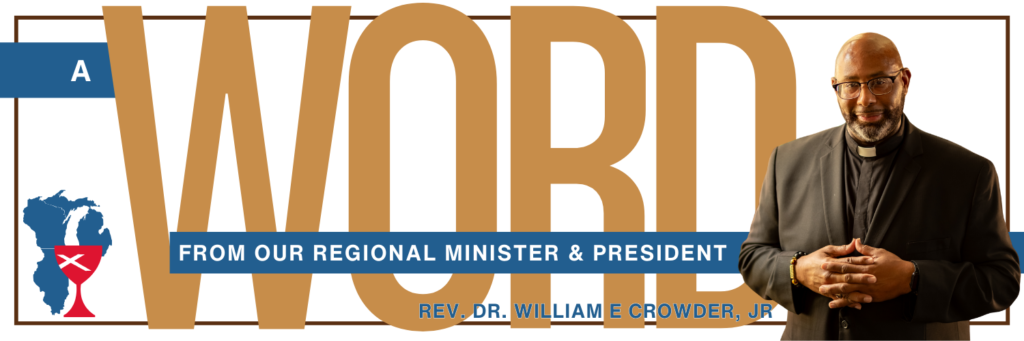
Rev. Dr. William E. Crowder, Jr.