
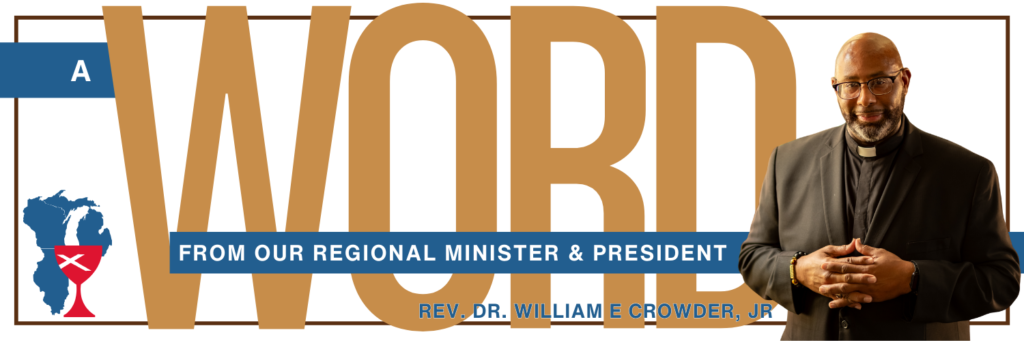
Dr. Crowder shared the following in a letter to future Living Waters Region Clergy on Thursday, July 30.
Witness in the Water: What People of Faith Must Say and Do About Access to Safe Drinking Water
Beloved Colleagues,
I was reminded once again of a concern that has been on my heart that I want to share with you —
— lead pipes and the cost of ignoring them.
In January 2024, I was invited by Global Ministries to learn firsthand about the global water crisis. During my 14 days in Ghana, I witnessed the realities of water insecurity, and the experience profoundly transformed my understanding of the vital importance of access to clean drinking water. What I witnessed deepened my conviction that access to safe, clean water is not merely an environmental concern, it is a matter of human dignity, public health, and faith.
Returning home, I began looking at my own community with new eyes. I live in the Chicagoland area, where many aging lead pipes still need to be replaced. While we often think of unsafe drinking water as someone else’s problem or a challenge faced in another country, the reality is much closer to home.
What about where you live? What about your family? Your congregation? Your neighborhood? Do you know the condition of the water infrastructure in your community? Have the lead pipes been replaced? If not, who is most at risk?
The call to justice often begins by asking a simple question: What is happening in my own community and what is God calling me to do about it?
Every time we turn on a faucet, we trust that the water flowing from it is safe. Yet for millions of Americans, that trust has been broken. Aging lead pipes continue to threaten the health of children, families, and entire communities.
Lead pipes cost us far more than money. They cost us health. They cost us educational opportunities. They cost us confidence in our public institutions. Most of all, they cost us our commitment to care for our neighbors.
Why Lead Is So Dangerous for Children
Lead is a powerful neurotoxin. There is no safe level of lead exposure for children. Even small amounts can interfere with the development of a child’s brain and nervous system.
Research shows that Children exposed to lead may experience:
Reduced IQ and impaired brain development.
Learning disabilities and difficulty concentrating.
Delays in speech and language development.
Behavioral challenges, including impulsivity and hyperactivity.
Memory and attention problems that can affect success in school.
Slower physical growth and developmental delays.
Because a child’s brain is still developing, the damage caused by lead exposure can be permanent. The consequences can last a lifetime, affecting educational achievement, employment opportunities, and overall health. Protecting children from lead is one of the most important investments a community can make in its future.
As clergy, these realities should concern us deeply. Jesus welcomed children, blessed them, and reminded us that caring for the most vulnerable is central to faithful discipleship. If we are committed to protecting children spiritually, we should also be committed to protecting them physically.
As clergy, we cannot remain silent when something so essential to life becomes a source of harm. Throughout Scripture, water is a symbol of God’s blessing, cleansing, healing, and abundant life. Jesus declared, “Let anyone who is thirsty come to me.” Water is meant to sustain life—not endanger it.
The Church has long understood that caring for God’s people includes caring for the conditions that allow people to flourish. Safe drinking water is not a luxury. It is a matter of human dignity.
What Should People of Faith Say?
We should proclaim that every child deserves safe water regardless of their ZIP code.
We should remind our communities that protecting public health is an act of loving our neighbors.
We should affirm that environmental stewardship is a spiritual responsibility. Caring for creation includes ensuring that the gifts God has given us are not contaminated by neglect or injustice.
We should speak with compassion rather than condemnation, recognizing that solving decades-old infrastructure problems requires cooperation among government, civic leaders, churches, and communities.
What Should People of Faith Do?
Pray for communities affected by unsafe drinking water and for leaders entrusted with making difficult decisions.
Educate congregations about local water systems and the progress being made to replace lead service lines.
Advocate for investments that protect vulnerable communities and future generations.
Partner with local organizations working to improve environmental health and public safety.
Support families who are directly impacted through practical acts of compassion, information sharing, and community outreach.
Ask questions in your own community. Where are the lead service lines? What plans are in place to replace them? How can your congregation be part of the solution?
As followers of Jesus Christ, we are called to care for both our neighbors and God’s creation. Clean drinking water should never be a privilege reserved for a few; it is essential for the flourishing of every community. Let us learn about the needs where we live, support efforts to replace aging infrastructure, and advocate for policies that ensure every child and every family has access to safe, clean water. Most importantly, remember that justice is not only preached from the pulpit but indeed it is practiced in the public square.
A Gospel Witness
The prophet Micah reminds us that the Lord requires us “to do justice, to love kindness, and to walk humbly with your God” (Micah 6:8). Replacing lead pipes may seem like an engineering project, but it is also an act of justice. It reflects our shared commitment to protect life, especially the lives of children and those whose voices are too often overlooked. The prophet Amos declares, “Let justice roll down like waters, and righteousness like an ever-flowing stream” (Amos 5:24). Safe, clean water is one tangible way we can embody that vision of justice in our own communities.
The Church has an opportunity to bear witness by reminding our communities that faith is not confined to Sunday worship. Faith calls us to seek the well-being of our neighbors every day. When every family can turn on the tap without fear, we come one step closer to reflecting the Kingdom of God… a place where justice flows like waters and righteousness like an ever-flowing stream.
My hope and prayer is that our voices, our prayers, and our actions will help make that vision a reality. May we also remember the words of the prophet Isaiah: “Learn to do good; seek justice, rescue the oppressed, defend the orphan, plead for the widow.” (Isaiah 1:17, NRSVue).
Amen. Ase’
Rev. Dr. William E. Crowder, Jr.