There is a story at the center of the Christian Church (Disciples of Christ) that too many Disciples have never heard.
It begins in 1917, with an African American businessman and minister named Preston Taylor who looked at the church he loved and saw, with clear eyes, that the welcome it proclaimed had not yet reached him and those who looked like him. African American Disciples were being excluded from the structures of the broader denomination — marginalized, sidelined, denied the full participation that the gospel they preached demanded. Taylor stayed. And he built.
What he built became the National Christian Missionary Convention — a space where Black Disciples could gather, worship, strategize, and pursue mission on their own terms, while remaining covenantally connected to the whole church. A declaration, in structure and in practice, that the open Table the Disciples claimed was either open to all or it was open to none.
In 1968, the Convention became what it is today: the National Convocation of the Christian Church (Disciples of Christ). More than a century after Taylor’s founding act, the Convocation continues to carry what he began — the prophetic witness of the Black church, held in covenant with the wider denomination, insisting that the gospel is good news for all people or it is good news for no one.
This is load-bearing history, the kind that, once you know it, changes how you read everything else.
Rev. Dr. William E. Crowder Jr. carries this history the way you carry something that has shaped your own formation — present in the bones, not retrieved from a shelf. As Regional Minister and President of the forthcoming Living Waters Region, the emerging unified expression of the Christian Church in Illinois, Wisconsin, and Michigan, he has spent his ministry at the intersection of the Black church tradition and the broader Disciples movement. He has also served as President of the Board of the National Convocation, concluding that tenure at the 29th Biennial Session in Dallas, Texas.
We asked him to help us understand what Convocation is, where it came from, and why its ongoing work is central to the future of the Christian Church.
For those who may not know: What is National Convocation, and why was it formed?
“Preston Taylor founded the National Christian Missionary Convention in 1917 because African American Disciples of Christ were being excluded, marginalized, and denied full participation within the broader structures of the Christian Church. The Convention created a space where African American Disciples could gather, strategize, worship, and pursue mission on their own terms while remaining part of the wider church. This movement laid the foundation for what would later become the National Convocation of the Christian Church in 1968.
In short, Preston Taylor founded the Convention not to divide the church — but to ensure that Black Disciples could fully participate in it with dignity, leadership, and shared power.”
What is something you wish every Disciple understood about Convocation’s role in our shared story?
“Convocation embodies a gospel that is both deeply spiritual and unapologetically justice-centered. It carries the traditions of the Black church — resilient worship, communal care, prophetic preaching, and social engagement — while remaining covenantally connected to the wider denomination. In a moment of polarization and racial reckoning, Convocation models what it means to tell the truth, love boldly, and remain rooted in hope.”
For a congregation in Illinois, Michigan, or Wisconsin wondering why Convocation matters to them — what would you say?
“Convocation matters because justice anywhere impacts the church everywhere. When one part of the body is strengthened, the whole body benefits. Convocation provides theological insight, leadership formation, and prophetic witness that enriches every region — including Illinois, Michigan, and Wisconsin. Supporting Convocation strengthens the entire Christian Church.”
What must the church revive? What must we reset? What are we being called to resist?
“We must revive our commitment to prayer, evangelism, and community engagement.
We must reset our assumptions about power, leadership pipelines, and what ‘success’ looks like in ministry.
We must resist racism, sexism, homophobia, injustice, theological complacency, and any ideology that places nationalism above the gospel.”
Where have you seen signs of hope?
“I have seen hope in young clergy answering the call. I have seen hope in seasoned saints who continue to show up faithfully. I have seen hope in congregations that are small in number but mighty in impact. And I have seen hope in renewed partnerships across racial and generational lines.”
As you conclude your presidency of National Convocation, what how does the theme of the Biennial shape the prayer you carry for the church?
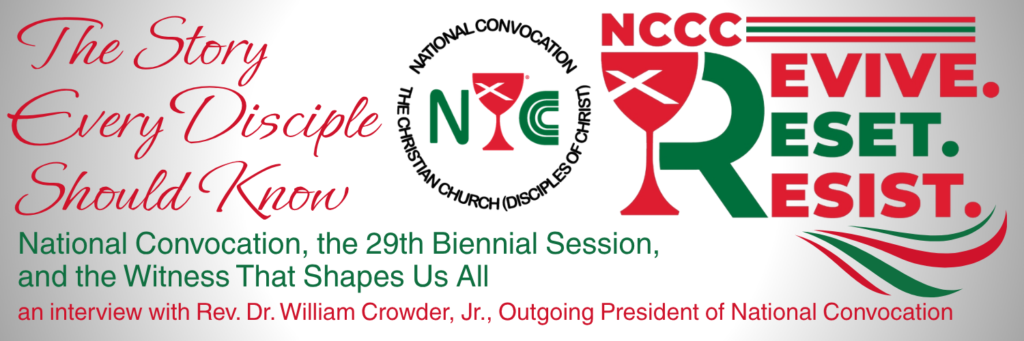
“Revive. Reset. Resist. speaks to spiritual renewal, strategic clarity, and prophetic courage.
Revive calls us back to the power of the Holy Spirit and the liberating gospel of Jesus Christ. Reset challenges us to examine our structures, priorities, and partnerships so that they reflect God’s justice — and not merely institutional survival. Resist reminds us that the church has always had to stand against systems that diminish human dignity.
It is timely because the church today faces fatigue, fragmentation, and fear. This theme invites us to return to our first love, reimagine our witness, and reclaim our prophetic voice.
My prayer is that the church would be courageous enough to change, humble enough to work to become better, and bold enough to proclaim good news to the poor. I pray that we will embody unity without uniformity, pursue justice without fear, and trust that the same Spirit who sustained our ancestors will guide our future.
Revive us, O God. Reset us for your purpose. Strengthen us to resist all that diminishes your beloved community.”
Rev. Dr. William E. Crowder Jr. serves as Regional Minister and President of the forthcoming Living Waters Region of the Christian Church (Disciples of Christ), the emerging unified expression of the Christian Church in Illinois and Wisconsin and the Christian Church, Michigan Region, effective January 1, 2027. He concludes his tenure as President of the Board of the National Convocation at the 29th Biennial Session, June 11–14, 2026, in Dallas, Texas.
Learn more about National Convocation at NationalConvocation.org.
Thank you for sharing this as i don’t believe I would have known otherwise.